Showing posts with label Market analysis. Show all posts

January 16, 2018

The Indian bitcoins

The following note is from upcoming annual letter to subscribers. I will be publishing the rest of the letter on the blog soon

When I look at companies which are priced a lofty multiples, I try to break it down to the first principle of investing – The value of an asset is the sum of its discounted cash flow over its lifetime.

A company with a high multiple, is not necessarily expensive if the company can grow its free cash flow for a long period of time. This means the market ‘assumes’ that such a company has a sustainable competitive advantage and a large opportunity space. Please note use of the word ‘assume’. The market is not some all knowing entity which can see the future. It is just the aggregation of the combined wisdom (or madness) of its participants.

The market on average and over time gets the valuations right, but not always.

As I look at several companies in the small cap and midcap space now, I am left wondering if investors really understand the implications behind the valuations. A company selling at a PE of 50 will need to deliver a growth of 25% for 10 years to justify the price. In order to make any returns for an investor buying at this price, the actual growth will have to be much higher and longer.

How many companies are able to deliver such growth rates for so long? Let’s look at some numbers from the past

In the last 10 years, we had around 233 companies in the sub 3000 cr market cap space, deliver a growth of 25% or higher. That’s around 6.2 % of the small/ mid cap universe. As the market cap/ size increases, the percentage of companies which can deliver this kind of performance only shrinks.

How many companies in the above space currently sport a PE of 50 higher ? around 22% or roughly 830. So 3 out of 4 companies in this group of ‘favored’ high PE companies are going to disappoint investors in the coming years in terms of growth

In other words, if you could buy all these ‘favored’ companies (greater than a PE of 50), you have a more than a 50% chance that you will lose money. Why would you take such a bet?

All investors in aggregate are taking this bet assuming individually, that their ‘chosen’ companies will not be the ones to disappoint. Ofcourse every individual thinks he or she is smarter, more handsome or <insert your criteria here> than the crowd (also called illusory superiority).

The odds are against everyone being right. So it makes sense to be cautious and do your homework well enough.  Some of these companies could turn out to be the bitcoins of our market: assets with promise but without cash flow. In such cases, the end result is likely to be unpleasant.

---------------- 
Stocks discussed in this post are for educational purpose only and not recommendations to buy or sell. Please contact a certified investment adviser for your investment decisions. Please read disclaimer towards the end of blog.

September 12, 2010

Ignore the index – clearing some confusion

As expected, my previous post got a lot of good comments and emails questioning my logic (and sanity :) ) . Most of the comments highlighted a lot of valid points against my assertion, that one should ignore the index when investing directly in stocks. I can bet a lot of you must have rolled your eyes when you saw the title and read the post :)

The main reason why my previous post may have appeared rash is that I did not explore all the nuances of investing, while ignoring the index. Let me start by highlighting some assumptions behind the previous post

- My key assumption behind the previous post was that the investor is investing for the long term and would not be bothered by short term fluctuations of the market or the stock price.
- The investor is a reasonably informed and diligent investor (a do it yourself kind of person)
- The investor has done his or her homework or analysis and has sound reason for believing that the stock is undervalued. In other words, the investor has evaluated the business well and believes that the company will do well in the long run (increase its intrinsic value).
- The investor is looking at building wealth in the long run and would be satisfied with above average returns (couple of percentage points above the index in the long run) and not looking at beating the index every quarter or year.

Let’s explore further by what is meant by investing while ignoring the index –

Sound fundamental analysis
The first requirement for this type of approach is that the individual has analyzed the company in detail and has good reason, backed by experience, to believe that the company will do well and the stock is also undervalued.

It is common to find undervalued and cheap stock during bear markets and market panics. It is however not a fact written in stone that one cannot find cheap stocks during bull markets and overpriced one’s during bear markets (hint – look at bharti airtel’s performance since Jan 2009 during which period the index has almost doubled).

When I suggested that one should ignore the index when investing in individual stocks, I did not mean that one should stop thinking and buy a stock which does not offer a good margin of safety. My assertion is that the process of evaluating a company and deciding if it is undervalued or not is not linked to the index levels.

A stock is undervalued if the current price is well below the conservatively calculated fair value of the company (which depends on the future performance of the company). This undervaluation or overvaluation does not depend on whether the index is overpriced or if it is raining in Timbuktu.

What if the market drops?
If you believe that company is selling below the fair value and you have confidence in the long term performance of the company, why does it matter if the market and the stock price drops after you have bought? Is it a tragedy that you bought a stock at a 50% discount to fair value and the stock went to 60% discount before eventually reaching fair value and giving you a 100% return in the process?

Is your approach to buy at the very bottom and sell at the absolute top ?

The problem with most of the investors is that they look at the short term price performance to validate their analysis. If you have that mindset, then it is very difficult to hold a stock for the long term as almost every other company which has given good long term returns has had short term spells of absolutely disastrous price performance.

The sole validation of your analysis should be the fundamental performance of the underlying business. If the company does well, the stock price will follow in due course of time. In the short run, the stock price will be influenced by market sentiments, news, liquidity and god knows what other factors. In the long run (usually 2-3 yrs), the price does catch up with value.

If on the other hand, the underlying business performance starts going south, then the best course of action is to sell and cut your losses (easier said than done). You will lose money in such a company even if the index goes up.

Buying the stock cheaper
The other argument I read repeatedly is that the stock price will come down when the market drops and an investor should be patient to wait for such opportunities.

I am all for being opportunistic and keeping some cash on hand to take advantage of such opportunities. I did not recommend that one should be fully invested during bull runs and not have some cash around if an opportunity presents itself. Asset allocation depends on several factors (age, target allocation % etc) and should be made based on your personal preferences.

Let’s say you do have ample cash and have to make a decision on a specific stock. If however you think that the market is too high and would like to wait for the market to drop to pick the stock cheap, then how do you know if the market will drop in 1, 3 or 8 months. In addition, can you be assured that the company will not keep doing well during this period and even if the market drops, the price may never drop to the current levels?

Finally, if you are confident that the market is going to drop soon (based on some logic or intuition), then are you buying index puts to benefit from it? If the market drops as you thought, then you will make money on your puts and also be able to buy the stock cheap !!!

Should you invest blindly during bull runs
I actually got accused of saying this in the previous post ! I personally don’t recall making this statement. Ignoring the index does not mean that you become blind to the valuation of individual stocks and start investing like a monkey.

It is true that stocks are usually overvalued when the market is in a bull run. Usually does not mean always and all the time.

My suggestion is this – disconnect the process of analyzing the stock and deciding whether it is undervalued or overvalued from the level of the market, GDP growth projection and other macro factors. One should focus on the specific factors which will drive the performance of the company and based on this assessment, decide if the stock is undervalued or overvalued.

If it is undervalued start buying! If you think the market will drop, then buy slowly and add to your position when the price drops. If you are wrong, then you would have missed a good opportunity. ofcourse all of this is easy to say and tough to execute.

The most cherished assumption
The market level seems to be one of the most fundamental drivers of buy/ sell decisions for most investors. I personally think it is worth evaluating this assumption and not dismissing it without thinking about it. You can always test it with a single stock or a very small amount of your capital and see if the assumption holds up.

The downside of this test is that you could lose a small amount of your money, but the upside is that it could open up a completely new way of thinking about the market and investing.

September 6, 2010

Ignore the index

I regularly try to understand the assumptions which drive my portfolio decisions, which in turn have a major impact on the long term returns . There is a fancy term for this process – meta congnition or ‘thinking about thinking’.

I have realized (and will continue to discover) that I have made sub-optimal decisions in the past due to various assumptions. One of the most damaging assumptions has been this – One should buy stocks when the market is low and sell when the market is high.

This assumption and way of thinking is more or less a stupid way of investing in the markets. I have engaged in it in the past and have paid a heavy price in terms of opportunity cost

Reason behind this thinking
I think the main reason behind this thinking is due the negative effect of all the media chatter and noise. The commentators on various financial channels are paid by the volume and not by intelligence. If a financial commentator recommended a great stock or great idea and then asked you check back after one year, do you think they will remain in business?

As a result of this bais (towards unnecessary activity), the media and a lot investors have to discuss about something. Now, you can’t discuss about the fundamental performance of stocks every day ..isnt it ? so what better topic to discuss than market levels and price action of various stocks?

Does the market level even matter ?
The first question I am asked after someone comes to know that I invest regularly is – do you think the market is high or low and should they wait for a particular level before they starting putting money into the market ?

What do you people mean by the market level ?

The market level is usually the index which in turn is a weighted average of a fixed number of stocks (for example nifty is an average of 50 stocks). So the notion is that the market is overvalued or undervalued at some number at a particular point in time.

The problem with this question is the market level is immaterial if you want to buy individual stocks. If the stock you want to buy is overpriced, then a low market does not matter and vice versa.

The only case where the market level would matter is if you plan to invest a large sum of money into the index.

How has this assumption hurt me?
I have engaged in this convoluted thinking in the past. As a result, I have slackened during bull runs assuming that most of the stocks would be overpriced. The reality is that even during bull runs there are stocks which are undervalued, but it takes more effort to dig them out.

I abandonded this thinking two years back and have started looking for good ideas irrespective of the market level. If the stock is underpriced, I will create a position in the stock irrespective of the market levels. If the market drops and the stock drops too, then all the better as I am able to add to my position further at a lower price.

A real example
One can have several counter points to the above thought process
- Should one not wait for the markets to drop so that you can buy the stock even cheaper?
- Will the stock appreciate if the market drops and remains at lower levels for extended periods of time?

To the first point – if you can see the future (know if the market will drop in the future), then either you are a gifted person or completely delusional. If you are gifted, then use your talents to do something big or world changing.
One cannot invest based on hindsight and we have to make decisions based on what we know now (the stock is cheap or not based on current facts!)

On the second point - The long term returns of a stock is dependent on the level of undervaluation and fundamental performance of a company and not entirely on the market level. As an example, in early 2008, mid cap IT stocks were among the most ignored group. The future was not bright for them.

I wrote about IT stocks (NIIT tech in particular) in Q2 of 2008 and felt that the market was over discounting the future. Interestingly the future turned out to be worse than anyone imagined. Inspite of that, these companies survived and have done fine.

The market has since then corrected the undervaluation and these stocks have doubled during this period whereas the index (aka market level) has been more or less flat.

Focus on the important and knowable
As warren buffett has said, an investor should focus on the important (fundamental performance of a company) and the knowable (current performance and not future market levels). The rest is noise and a smart approach is to ignore it.

June 28, 2008

Where does the index stand ?

Update 29th - I missed an important point when i posted on 28th. The data for the index is non-stationary. What it means that the underlying composition of the index is not fixed and the various other parameters such as interest rates, inflation are changing too. As a result the index of 1995 is not the same as the index of 2008. One must be careful from drawing too many conclusions from the data. It is good to analyse the data and have a perspective, but dangerous to make invest decision based on it alone. It easy to say the index is overvalued if the PE is above 30 or undervalued if it drops below 10. However it is not easy to arrive at a firm conclusion if the PE is 15 or 18 or similar such levels.

----------------------------------------------------------------------------------
I am not planning to make any forecast on where the forecast will be in the next few month. However I have done some analysis on the sensex and nifty index and uploaded it in the google groups. You can check here to download the file Quantitative calculation 2008.xls and check the first worksheet – market valuation.

The numbers for june 2008 are computed for both the sensex and the nifty. A few observations

1. The current PE for the sensex is around 16.8 and 17.7 for nifty. By historical standard ( history is few years back, not a few months) it is not too low. Just about towards the upper end of the PE band

2. The Return on equity (earnings/book) is still pretty high by historical standard. In the 90’s the numbers were generally low in 14-19% range. The last 3-4 years were actually an exception. We had a confluence of positive factors. Low interest rates, high demand growth and high capacity utilization all resulted in high returns. Companies had also re-structured and so net margins and ROE have been high in the past few years. The business cycle may be turning, with interest rates and inflation creeping up. We could revert to an average ROE of 18% (still higher by historical standards)

3. The Earnings growth has been 20%+ in the last few years. This has slowed down to around 10-12% in the current year.

Lets do some scenario analysis. For sake of assumption lets look at some probable scenarios on factors which are based on fundamentals

Book value is around 3540. An ROE of 18% which looks like a fair no. (look at the data for the entire 90s till 2003. I am still assuming a higher number). So normalized earnings is around 640 Rs which is lower than the current number of 820. What this means the earnings growth could slow down over the next few years as ROE reverts to the historical numbers. It is important to remember that ROE, unlike PE is not driven by market pschology. So the historical numbers do count in case of ROE.

For PE looks at the years 96-98. Interest rates were high and market PE ranged between 14-17.

Now for a juicy forecast – lets say earnings grow to around 900 in 2 years (book value will have to grow by 20% per annum and returns will drop to around 18% for that, so it is not impossible) and the PE is around 16-18, we are looking at a range of 14500- 16500.

Keep in mind that the assumptions in arriving at these numbers are still optimistic. We are still assuming reasonable growth in book values, moderate drop in ROE and fairly decent multiples. If things turn out better then we could have another bull market. But if we revert to historical levels, even on some variables such as ROE or PE or growth, then even the current market level is not too low.

Ofcourse other than the data, everything else in this post is a hypothesis. So my guess is as good as yours.


For an analysis of the index 2.5 years back see here

May 29, 2007

Value in midcaps ?

I have written earlier that there seems to be more value in the midcap space than Large caps represented by the Sensex and Nifty. The above hypothesis came about as I am finding far more ideas in the midcap than the large cap sector of the market.

I decided to check the above hypothesis and generated the above two charts for the Nifty index and CNX midcap. The nifty index has appreciated by around 23% in the last year, whereas the midcap index has increased by around 13 %. Does this prove my hypothesis. Yes and no !. Yes because some of the stocks have come down quite a bit and may be worth investing. No, because the midcap index as a whole is not too cheap, currently trading at around 17 times PE.

So blindly buying into the index may not make sense, but picking specific stocks would.

Based on the above view I tried to look for some mutual funds in the midcap space and found the following interesting. I am listing the negatives of each of the funds. The returns of the funds have been fine and they may be worth a look

Birla midcap – This is a 5 star fund. It does not have a very long operating history. The fund has been around 3 years and the last 2 years performance has not been great

Sundaram mid cap – This fund has delivered good performance in the long run. However the last 1 year performance has not been great. Also the fund has a new fund manager. The fund is extremely spread out and has more than 70-80 stocks in the portfolio

Franklin prima fund – This fund has the longest operating history. It has done well in the past and the fund manager has been around from the beginning. The manager follows a buy and hold philosophy and has higher portfolio concentration. The last 3 year performance has been average though.

As usual, the fund expenses are high and the volatility of these funds is also high. An SIP mode of investment may be a good approach.

In addition, funds like HDFC equity and Franklin prima plus have a diversified approach and can move between various caps. These funds may also be good way of investing in the mid-cap space too as HDFC equity has around 50% exposure midcaps and Franklin prima plus has around 35-40% exposure to midcaps.

You can look for the details for each fund at valueresearchonline.com. I am not recommending any of the above funds, just laying out the facts for some funds which I find worth investigating further in the midcap space. A superior approach would be to pick specific stocks, but that requires a higher amount of effort and time.

April 8, 2007

A bi-polar market

I typically do not invest based on the market cap of companies. Though I have a cutoff of 100 crs for market cap when filtering for investment ideas, I do not give it anymore importance than that.

I have been reading a few articles that the midcap sector of the market seems to be performing poorly as compared to the index. As I hold several midcap stocks in my portfolio, I decided to check the validity of this view.

I checked on the performance of the midcap index and compared it with the nse nifty. Since april, the midcap index been in a bear market and has dropped by around 2-3% whereas the nse nifty is up 7-8 % (see under statistics section of the nse india website)

In addition, my stock filters seem to be turning up a few good ideas in the midcap space.

The above thought does not mean that I am planning to rush out and buy midcap stocks indiscriminately. However the small cap and midcap space is now a good place to look for new ideas

You can find are recent post on market breadth
here on galatime.com


December 19, 2006

Fortune’s formula

I have been reading this book : Fortune's Formula: The Untold Story of the Scientific Betting System That Beat the Casinos and Wall Street.

I have found this book quite good especially if one wants to learn about odds, betting etc.

I am just halfway through the book. The book discusses about the kelly’s formula.

F = edge/odds. I have written about this formulae earlier (see
here).

I found the above formula intersting although I have yet to figure out, how to use it directly in investment management. The formulae works well for betting situations like blackjack, horse betting which have limited outcomes. Its diffcult to work out mathematically the value of edge and odds in a common stock situation.

I have also been doing some analysis on the NSE data and have the following data


The above is the distribution of PE ratio for the last 7 years. It clearly shows that the only for around 8% of the trading days has the PE ratio been higher than 22.

If we take the above numbers as proxy for probability of occurrence and multiply that with the gain/ loss ( current PE – PE of the particular day / current PE) for each day, the expected value is around –19%.

To cut a long story short, the market seems to be overvalued by historical measures (which may not mean that the market is overvalued if the future performance is better than expected). Overall, I am planning to be more cautious especially in investing in the index (via index funds or ETF)

update : 8-Jan : Found this interesting discussion thread on the Berkshire board on MSN on the same topic. For those interested in kelly formulae, i would recommend reading the thread

http://groups.msn.com/BerkshireHathawayShareholders/general.msnw?action=get_message&mview=0&ID_Message=26958&LastModified=4675605385636001835

February 8, 2006

The sensex at 10000 ...a historical perspective


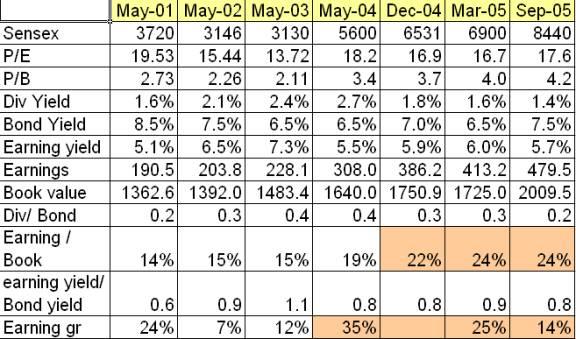
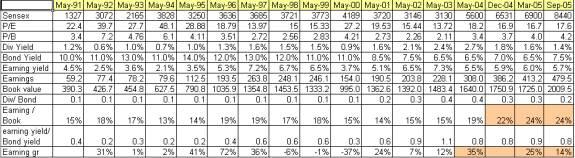
It’s difficult to miss that the sensex is at 10K. Frankly, I personally think that 10K is no different than 9900 (ofcourse it is 1% higher). Fundamentally nothing much has changed when the sensex rose from 9500+ to 10K. But at the same time with the index at these levels, I updated my worksheets and generated the graphs above. What does the data tell (and everyone will have their own interpretation)

- ROE is 20% +, highest in the last 15 years. This clearly shows that the cost cutting and restructuring that indian companies went through, has paid off.
- Earnings which were roughly flat between 1997 and 2003, have exploded since then. The reason is not diffcult to see. Good economic growth, higher efficiency due to the restructuring, low interest rates etc etc.
- P/E ratios do not appear very high, but have to be seen with reference to the ROE which is above the past averages and the earnings growth has been very high.

So does the data give me an insight into what is likely to happen in the future?

ROE appears high and may come down a bit in the future to the average levels. But on the other variables like PE (which is dependent on market psychology) and earnings I frankly don’t have any special insight. My guess is as good as anyone else’s. For now, I am not doing much in terms of buying or selling.

But the price levels on some of the individual securities which I own, are now in the ‘alert’ range. What I mean by alert is that once the price crosses my upper estimate of intrinsic value, I relook at the scrip and start selling slowly (around 5% for every 2-3 % price increase). Why 5 % for every 2-3% increase. Nothing scientific or smart about it. I have developed this approach so that if the price keeps increasing I am able to sell at a higher average price and don’t feel regret of losing out on the gain. Conversely if the price starts dropping, then I end up doing nothing (as the scrip is now below my estimate of intrinsic value).

January 5, 2006

Stay away from the stockmarket ?

Found this post on mark cuban’s Blog

The Stock Market is for suckers….

I agree with mark’s basic premise which is that one should invest in the stock market only if one has an edge. However I do not agree completely with mark’s extreme view that the stockmarket is a place for suckers and there is always sucker on one side of a trade (although a lot of times there is one). The stockmarket is not a zero sum game and if one can avoid the extremes emotions of greed and fear, then one can get a resonable rate of return. Even on a trade, the buyer and the seller need not be a sucker. The seller may not be comfortable with the risk associated with the stock, may have achieved his targeted return or could be selling for some personal reason. The buyer on the other hand may have a similar view point, but could more comfortable with the risk on the stock, or could be hedging his position on some other stock.

I would say as an individual, I can have the following edge over the market


  • long term view : If I have long term view and can think beyond the immediate short term view point of the market, then I can find some good long term investment opportunities. For ex: FMCG in 2004 and early 2005 were good investment opportunities when the market was bearish about the short term outlook of this industry.

  • Investing in one’s circle of competence: As charlie munger’s says, it is not in human nature to be an expert in everthing. But if one works hard at it, then one can become an expert in a few areas. For me my circle of competence is limited to FMCG, industrial and a few other industries. So as long as I limit myself to these industries I should do fine. Ofcourse it means that the number opportunties are sometimes limited if these sectors are overvalued. But then as an individual one has the luxury of investing only when the opportunity is right.

  • As an individual investor, I have the luxury of being out of the market when I don’t find any values. A proffessional investor cannot do that

But at the same time, if one strays from his circle of competence and gets swept by greed or fear, then I think it is closer to gambling than investing (where the odds are against you )

Mark talks about technology investing in his post. Substitute ‘technology’ with any industry which is outside your circle of competence and I think the result would be the same. I think if one does not invest the required time to develop a deep understanding of atleast a few industries, then it is difficult to get a return higher than the market.

December 14, 2005

One way of looking at market valuation ?

I have followed a thought process (and here) in terms of looking at market valuation in terms of PE bands. So if the market is below a PE of 12 or below, it likely to be undervalued (odds are favorable for an investor – to the tune of 7:1 or better). At the same time if the PE is more than 20, the market is moving towards overvaluation (unless there is a recession in the economy and earnings are really depressed) and the odds are against an investor (1:3 or worse). However, I found it difficult to form a firm opinion between the above PE levels. The market is typically between these two levels 60-70 % of times and as result I am inactive and not buying an ETF or Index funds. However if the market drops below a PE of 12 or below, I usually start buying actively and if the market goes above a PE of 20, I start a slow liquidation.

I don’t use the above approach to individual stocks, where it is possible for me to have a better idea on whether the stock is over or undervalued (provided the stock is in my circle of competence).

I was pleasently surprised to find the following reply from Warren buffett in his Q&A at Wharton.

I would suggest downloading the Q&A (pdf) and going through the complete transcript for other nuggets of wisdom from buffett.


Q: You made an argument for 7% returns over the next decade in Fortune. Given that (1) profit margins are at least 30% above historical averages, (2) the ratio of prices/GDP is at least 25% above historical averages, and (3) interest rates are ~25% below historical averages, assuming mean reversion, wouldn’t one conclude that while economic earnings growth plus dividends may be 7%, that we are at an unsustainable valuation plateau?


A: We are near the high-end of the valuation band, but not really at an extreme. I have commented on the market 4 or 5 times in Forbes interviews previously (1969, 1974, 1981, and 1977 in Fortune). Most of you can say if something is overvalued or undervalued, you can spot the occasional extreme cases.
There is a big band of valuation and the idea is to calibrate extremes. When I look at a business, I look for people with passion. I can recognize a 98 or a 6, not a 63 (emphasis mine). This rule is good enough in life and investment. You refer to my 2001 article, but returns have not exceeded 7%, so I guess that this is not that precise of a band.


October 28, 2005

It is easy to know what will happen in the market, but difficult to know when

The above comment is from warren buffet. He has also written in the annual letters that he prices the market, rather than time the market. The difference is substantial between the two approaches. The first one, is based on valuation and understanding when the market price is way above the intrinsic value and then going ahead and selling the overvalued security.

The second approach of timing the market is based on psychology of the market and is very difficult (at least for me) to do consistently. People try technical analysis, charts etc to time the market and there could some investors out there who could be good at it. But I have never tried it, as it is too difficult and not really productive for me.

The approach in ‘pricing’ the market works in areas beyond the stock market too. Let me give a personal example

Interest rates in India have fallen for quite some time. From a 10% in 2001 to around 6-7 % by 2004. This was the time to be an investor in debt as debt funds gave good returns. In 2004 I was looking at a housing loan and had an offer of 7.75 % fixed versus 7.25 % Variable. The loan officer ofcourse was very enthusiastic about the variable loan and kept pushing it. I however was keen on the fixed loan and had worked the following math (with assumptions)

Long-term inflation – 5-6 % (assumption on the lower end, can be higher)
NPA – 0.5-1 %
Cost of loan servicing for an HFC – 0.25 – 0.5 %
Return on asset – 1.5 % (for an HFC to earn a reasonable return on equity)

The effective cost (rate an HFC should charge me) should be around 7.5 % - 9 %. So with all the optimistic assumptions built into the ‘value’ of the funds, it should not be priced below 7.5%.

As the bank was offering 7.75 % fixed for a tenure of 20 years, I felt the loan was underpriced and opted for a fixed rate loan.

I could be wrong in my decision if
  • Inflation for next 20 years remains below 5 %

  • NPA for most of the HFC are below 0.5 %

But the odds are that over a 20-year period, we could have periods of high inflation and high NPA. So I went ahead with the fixed rate loan. At the same time I moved out of debt funds and into floating rate funds.

I found the approach of pricing (and working on odds) the market much more productive. I am not right immediately and so there is no instant gratification (all my friends in 2004 kept saying that floating rate is the way to go). But if my logic is correct and I make a rational, informed decision, it has worked out for me.

Please share any such experiences you would have had


September 28, 2005

Am I too pessimistic about the market

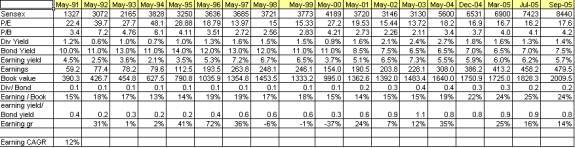
I have been asking this question time and again to myself . Am I being too pessimistic ? I have some statistic below which I calculate to see how the over all market is looking like in terms of valuation and fundamentals ( extending back to 1991)


Return on capital, earnings growth seems to be at an all time high. The earnings have more or less doubled in the last 2 years. As a result the valuation do not seem to be stretched. The market is definitely not as richly valued as 2000 or 1992-93. At the same time the earnings growth , return on capital and interest rates are much lower than what we had at that point of time.

At the same time, will it get any better going forward. Can the Return on capital improve further, interest rates fall further and earnings growth improve further ? My thought is that the odds are low ….

But does it mean that one needs to sell or the market is ready for a crash ?? again I don’t think that is likely. I have not been able to come to a definitive conclusion and hence have chosen to do nothing ( not buying and not selling ).

Maybe another 10% increase in the market in the next couple of months could change my mind

September 21, 2005

Cannot find much to invest in these days

Cannot find much to invest !! I typically run screens provided by icicidirect. Most of the companies being thrown up below a PE of 10-11 (I keep a cutoff at 10-11 as I think that would be the approximate value of a company with no growth and returns at cost of capital. So any company having growth and a ROC of greater than Cost of capital would be worth more).

Sample of some companies which came up

- EID parry: In commodity industry (sugar etc) and selling at 16 times peak earning (the screen was wrong and did not consider the 1:5 split.
- Banks: Several banks like Karnataka bank etc came up. Need to check if any banks would have value
- Tata steel, Essar steel, Gujarat ambuja cements – Commodity companies selling in low teens of Peak earnings. Would not be looking at investing at peak / uptrend of business cycle. Also PE is generally a poor indicator for cyclical companies. Generally during downtrends these companies would sport a high PE on depressed earnings and that could be a good time to invest.
- UB holding – A Loss making holding company selling at a CAP of 1100 crores. Tangible assets appear in the range of 300-400 crores. They could have some undervalued assets on balance sheet such as land holdings at cost, Investments in subsidiary companies. Looks unlikely to be worth more than 800-900 crores. I will need to look closely.


Any good ideas ??

September 15, 2005

Is the market overvalued ?

I have been reading a lot of analysis on the market valuation levels. A few articles are citing that at a PE of 14 - 15 the market is not too overvalued and should give good returns.
On the other hand , some statistics show that market is fairly or overvalued as the ROE for the indian industry is at its peak, Interest rates low, inflation low and the demand robust. As a result we are seeing these PE levels which are at the peak of a cycle and the normalised PE should be close to 17-18.

I find both arguments plausible, but my money is on the overvaluation side. I have become fairly cautious for some time and would be looking at initiating selling if the markets keep rising.

Also the overall market valuations are important if one is invested in index funds or ETF's. Otherwise rather than concentrating on the market, i am looking at my individual holdings and would start reducing them if they start getting more overvalued (i think some are fairly close to their overvaluation levels)

Although i am not invested in commodity companies, i would look at their valuation levels more closely and would even look at selling them as my thought process is that commodity cycle is at a peak and industry profits are at a cyclical peak (for steel, cement etc ) due to robust demand, high capacity utilisation, low debt and interest level. PE for these companies is very low and i would not base my evaluation on those PE as the earnings are at a cyclical peak. In addition a lot of capacity addition is starting now, for ex: Tata steel seems to have announced a huge capex plan. So i would be wary of putting any money or holding onto commodity companies

Any thoughts ? please share with me

August 24, 2005

If the market is falling ..why am i smiling ?

for the same reason, when the price of a computer, telecom charges, or any other stuff which i need to buy falls !!

It allows me to buy more of it ....

The above way of thinking is ofcourse not original ...kind of learnt it from warren buffett. But having internalised it, it makes a lot of sense

so every day when the market falls , i smile and hope that the stocks which i am wanting to buy and have not been able to, would be available soon at a good price

July 24, 2005

Risk Reward ratio not in favor of investors at 7400 levels

Read this interview of chetan parikh (he runs the excellent website capitalideasonline ). He is an exceptional investor from the graham - buffett school of investing and among the few investors whose views i respect.

The complete interview is available in moneycontrol website

http://news.moneycontrol.com/backends/News/frontend/news_detail.php?autono=174200

some snippets below

He says, "I would be comfortable with the levels being below 6000, because if the market goes below the 5500-6000 levels, there would be a lot more trading opportunities. But at this point of time in the market, it is difficult to find stocks with a large margin of safety."
He adds that, a good band of
trading for the market would be between 12-18 times earnings, and on that basis the Sensex should be anywhere between 5000-8400 levels.
Parikh says, "At the 7300 levels, the risk reward is not in favour of investors. This does not mean that the markets cannot go up, because on liquidity the markets can go even upto 8000 levels and past that. But from the risk management point of view, the odds are not in favour of the investors, from a one year perspective."


He says, "My sense is that the operating margins have peaked, and going forward, operating margins could come under pressure. A whole lot of companies have gone in for capital expenditure, and therefore the return on capital employed will come down. We are also seeing the bottom of the interest rate cycle, so there will be a pressure on margins, on return on net worth and capital employed, in the future.

i would completely with his analysis on the return on capital and other fundamentals. The BSE sensex stocks at an aggregate are returning 20 % + ROE (with the past no.s around 16-18 % at best ). So although the pe are not high , i would kind of wary of putting any more money. on the contrary i have started looking at reducing some of my holdings which seems to be get in the over valued territory.

July 3, 2005

The market at 7200 ! so what ??

Look at any financial website / papers and there is euphoria all around ...

Cant figure out a rational reason other than that it is good to excite people, get more hits or sell copies.

what's the big deal about 7200 !! or any other number .

The market is selling at 14.3 times backward pe . If the economy does fairly ok , and the corporate profits continue to grow at 10-15 % , then some time in the future we could have the sensex touching 8000 and then maybe 8900 ...provided there is no major shock to the world economy / indian economy ... anyway how does it matter

well if the market was selling at say 20 times pe , then it would matter as i would start selling ..or if it was selling at say 10-11 times pe (like 2003 ) then it would matter ...as one can buy some very good companies at good prices ...but now we have pockets of overvaluation and to be fair pockets of undervaluation ...so it means more work ..

so i guess if the markets shoots to 8000 + soon or drops to 6000 types , then it is action time ...otherwise it is back to reading annual reports and better off watching the discovery channel

seems like a lot of noise ..but then what can once expect from the most of the financial media !!

January 27, 2005

Quarterly results season is upon us

Initial analysis shows good performance from major companies. Major companies continue to do well. The profit growth is good. Return on capital is good. This is inspite of supply side inflation due to rising oil and commodity prices, high competition.

The market at 6500 does not look too expensive , provided corporate india is able maintain its return on capital (read efficiency), inflation remains moderate and the goverment doesnt do something stupid.

Most of the news channel / website are talking of record highs in the stock market. This is clearly rear mirror view. The absolute level of the stock market does not matter. The current levels should be analysed keeping in mind the following factors

1) return on capital for corporate india - currently 20% plus
2) inflation - moderate inspite of oil prices
3) robust demand

All in all the overall corporate performance gives me confidence to hold on to my positions , maybe add to a few too

December 28, 2004

Is the indian stock market expensive ?

I would value the market like a stock ( the Sensex or the nifty is essentially a combination 30 or 50 stocks )

I would look at three factors to judge whether market is expensive or cheap

a) The current return on equity of the market as a whole
b) The current interest rates
c) The forward growth rate expected of the market

a and b are facts and c an estimate and hence any judgement is an estimate.

The current rate is around 18-20 % ( i do have exact numbers ). The interest rates (risk free) is around 7 % . Both these numbers from historical perspective are better than the average.The returns have been a bit lower and the interest rates a bit higher.

The forward growth rate can be conservatively be estimated at atleast the GDP growth of 5 % ( last decade number ). In reality it has been around 10 % but it always pays to be conservative

So with these three inputs and with some historical perspective that the average PE of indian markets have been 15-16 on average , we can assume that the market is slightly undervalued (from a long term perspective)

If the indian industry keeps doing well ( rate of return holds) and the inflation does not spike, the current levels do not look overlvalued

In my entire analysis there are'nt too many hard figures ...only expectations and assumptions

Well any 'expert' or layman (like mine) opinion is just that - a set of expectations and assumption which subsequent events can invalidate

So what i am doing - well for one not selling the index ( which one can through futures or ETF ) , but not buying too , because the market does not give a 'margin of safety' at these levels


May 17, 2004

market now offering 10:1 odds

with a 12 % crash the market now offers a 10:1 odds (less that 10 % loss ) on a long term basis.

nse website gives the 5 year daily pe from jan 99 to till date. using that data shows that the nse index has gone below a pe of 12.9 (current pe ) only 10 % of the time.

although this may not hold true going forward , the risk reward is now favourable for a rational and patient investor. with the current risk free rates at 6 % and high ROE , the market is in an attractive zone